
Crisis Intervention Program (North Carolina CIP)
Last updated August 2026
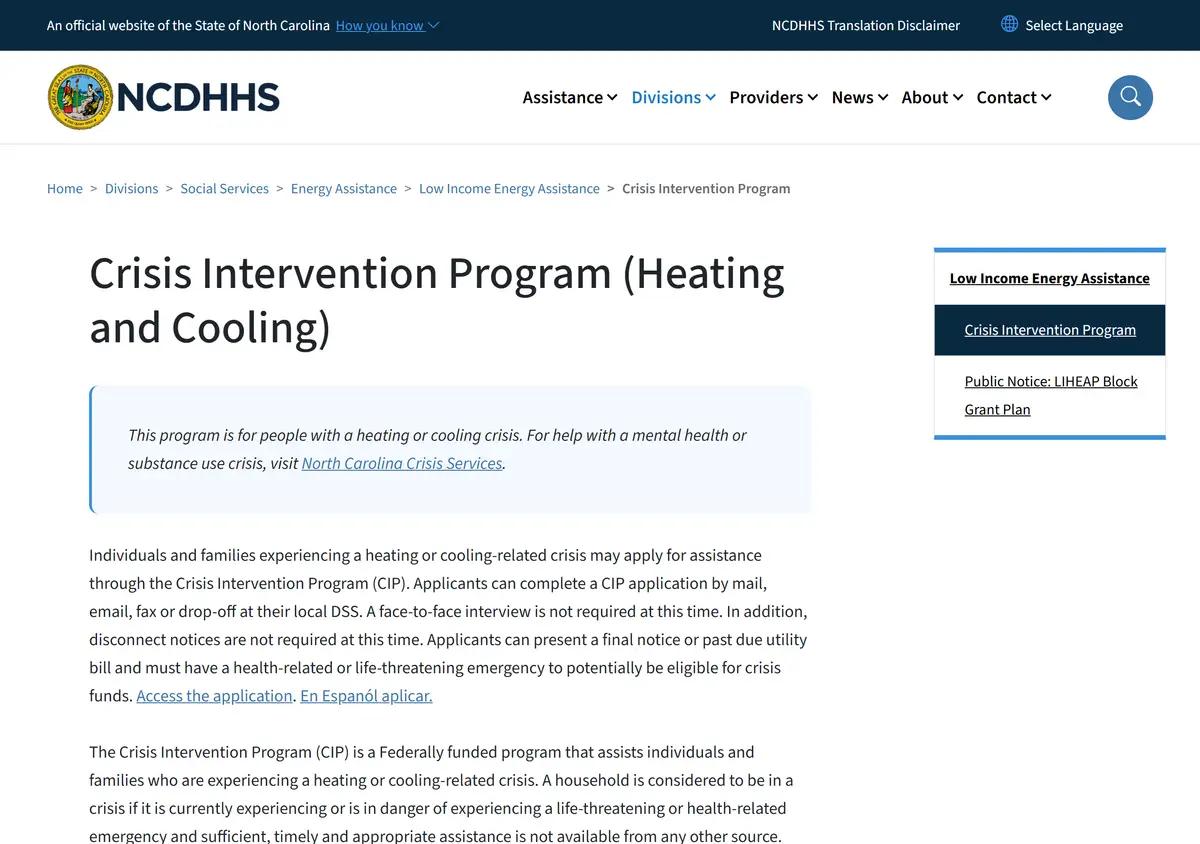
The Crisis Intervention Program, CIP, is North Carolina's help for a heating or cooling emergency. If your household faces a life-threatening or health-related energy emergency, this is the program to name. Unlike LIEAP, which only runs in winter, CIP is open year-round and covers both heating and cooling. Apply at your county Department of Social Services.
A crisis has a specific meaning here. Your household is in crisis when it is experiencing, or is about to experience, a life-threatening or health-related emergency tied to heat or cooling, and no other timely help is available. Having no working heat or cooling counts when a household member's health would be endangered. So does a disconnect notice.
The current rules cut the usual red tape. No face-to-face interview is required. You do not even need a disconnect notice; a final notice or a past-due bill showing the amount owed is enough. Applications are accepted by mail, email, fax, or drop-off at the county DSS, and you can also start energy assistance online at ePASS. Call your county ahead to ask which method moves fastest where you live.
The gates are wider than LIEAP's on income, tighter on savings. Income can go up to 150 percent of the federal poverty level, compared with LIEAP's 130. Resources must be under $4,500 for households with a member who is 60 or older or disabled, or under $3,000 for everyone else. At least one household member must be a U.S. citizen or eligible non-citizen.
CIP runs on a July-to-June year, and each county has an allocation that can run dry. The program pays what it takes to resolve the specific emergency, so the paperwork centers on the bill, the notice, and your income. Apply the day the emergency starts, not the day the power goes out.
Do not stop at CIP. Once the immediate danger passes, the Weatherization Assistance Program lowers future bills by fixing the home, and 2-1-1 knows the local churches and funds that also help with utilities. If money is this tight, let ePASS check you for Food and Nutrition Services and Medicaid too.
Who qualifies
- Your household must be experiencing or about to experience a heating or cooling crisis, such as a service disconnection or a home with no working heat or cooling
- Income-eligible households qualify; the county verifies the emergency and the amount needed to resolve it
You may qualify. The program makes the final decision.
How to apply
- 1
Contact your county Department of Social Services as soon as an energy emergency starts. No disconnect notice is needed; a past-due bill works.
- 2
Ask which method is fastest: mail, email, fax, drop-off, or starting online at ePASS.
- 3
Submit your bill or final notice, proof of income, and household information. No interview is required.
- 4
Ask about LIEAP and Weatherization in the same conversation.
What to have ready
- A past-due bill, final notice, or proof your heating or cooling is out
- Proof of income and household members
- Proof of resources like bank balances. The county confirms the exact list.
What the application looks like
Common questions
What counts as a crisis for CIP in North Carolina?
A life-threatening or health-related heating or cooling emergency with no other timely help available. No working heat or cooling, or a disconnect notice, counts when a household member's health is endangered.
When can I apply for the Crisis Intervention Program?
Year-round, on a July-to-June program year, until your county's funds are spent. Unlike LIEAP, CIP is not limited to winter and covers both heating and cooling emergencies.
Do I need a disconnect notice or an interview?
No to both under current rules. A final notice or past-due bill showing the amount owed is enough, and no face-to-face interview is required.
What are the income and resource limits?
Income up to 150 percent of the federal poverty level. Resources under $4,500 if the household has a member 60 or older or disabled, under $3,000 otherwise.
Can I get both CIP and LIEAP?
Yes. They are separate programs at the same county office. LIEAP is a one-time seasonal heating payment; CIP is the year-round emergency fund. Ask about both.
Not sure this is the right program for your situation?
See all North Carolina programs →Free · Private · No account needed