
Michigan Home Heating Credit
Last updated August 2026
The Home Heating Credit is Michigan money for winter heat. Most people can claim it without filing a tax return at all; form MI-1040CR-7 stands on its own. The one unbreakable rule is the deadline: September 30, no extensions.
Renters qualify, homeowners qualify, and even renters whose heat is baked into the rent qualify; their credit gets reissued as a check. The main exclusions: full-time students claimed as dependents and people who lived all year in college housing or licensed care facilities.
The math runs two ways, and the form picks the better one. A standard allowance by income and household size, with ceilings from $17,243 for a single filer to $35,385 for four exemptions. Or an alternate credit based on your actual heating costs, with its own income caps.
Delivery has a Michigan twist. Pay your own heat? The credit arrives as a State Energy Draft you hand to your heat provider. Any excess comes back to you if you check the box on line 46. DTE, Consumers, and SEMCO customers may see it go straight to the utility.
Avoid the classic mistakes: filing after September 30, listing monthly instead of annual income, forgetting household resources like cash gifts, and not checking box 10 when heat is in your rent. Forms are auto-mailed to last year's claimants and stocked at Treasury, libraries, and MDHHS offices from late January. One interaction to know: receiving the credit can affect your food assistance amount.
Who qualifies
- You must rent or own and occupy your Michigan home and meet the income limits in the form's Table A; the credit targets low-income, senior, disabled, and blind residents and disabled veterans
- You can file the MI-1040CR-7 on its own if you do not otherwise have to file a Michigan return; the deadline is September 30
You may qualify. The program makes the final decision.
How to apply
- 1
Get form MI-1040CR-7: auto-mailed if you claimed last year, or from Treasury, libraries, and MDHHS offices starting late January.
- 2
File it by September 30, on its own or with your MI-1040. No tax return is required, and no extensions exist.
- 3
List ANNUAL household resources, including cash gifts and dependents' Social Security; monthly figures are the top filing mistake.
- 4
Heat included in rent? Check box 10, then return the energy draft with your lease to Treasury for reissue as a check.
- 5
Want leftover credit as cash? Check the refund box on line 46 when you give the draft to your heat provider.
- 6
Track your claim through Treasury's Individual Income Tax eService.
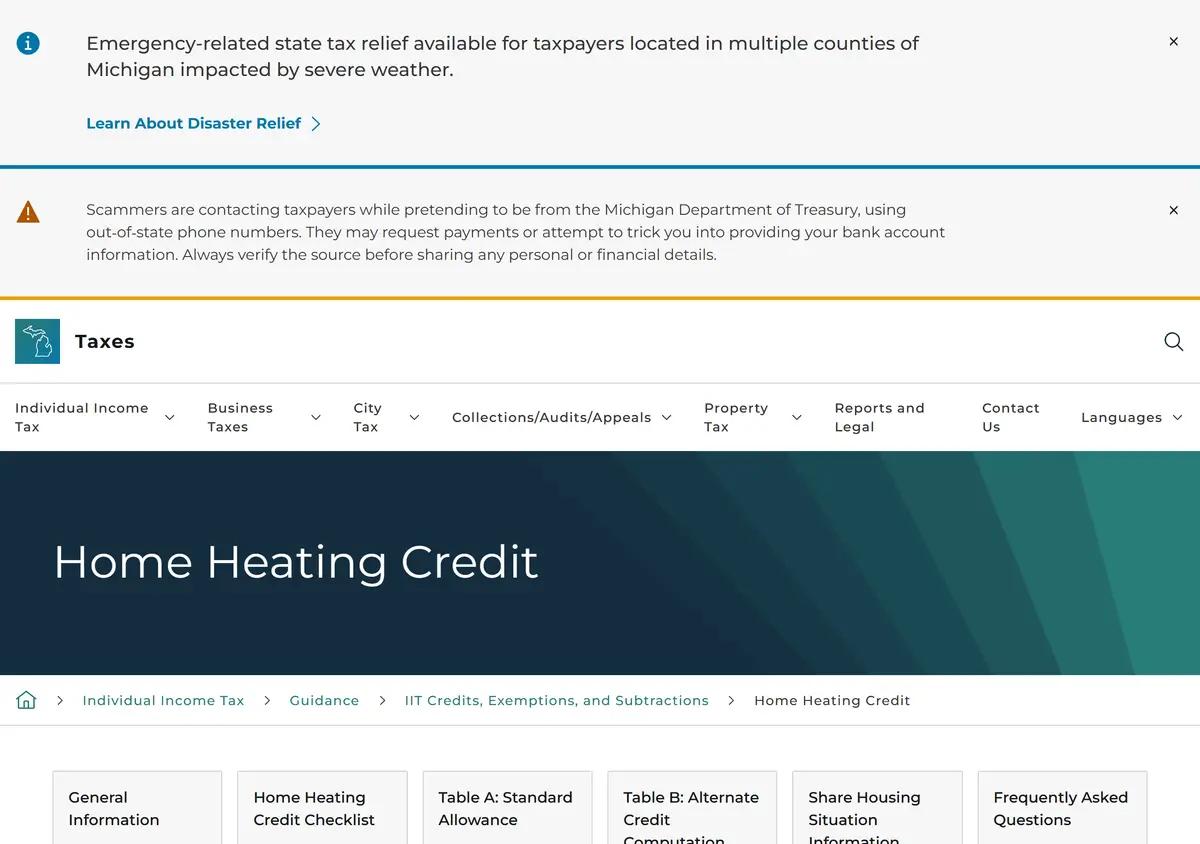
What the application looks like
Common questions
Do I need to file a tax return to get the Home Heating Credit?
No. Form MI-1040CR-7 can be filed entirely on its own, by mail or electronically. The deadline is September 30 with no extensions.
Do renters qualify?
Yes, including renters whose heat is included in rent; their energy draft is reissued as a check when returned to Treasury with a lease copy and box 10 checked.
What are the income limits?
For the standard allowance: $17,243 with 0-1 exemptions up to $35,385 with four, plus $6,057 each additional. The alternate credit, based on actual heat costs, has its own caps ($34,227 for four or more).
How does the money arrive?
If you pay your own heat, as a State Energy Draft you hand to your heat provider, with excess refundable via the line 46 checkbox. DTE, Consumers, and SEMCO customers may see it go straight to the utility.
What mistakes delay claims?
Filing after September 30, entering monthly instead of annual income, omitting household resources like cash gifts, and skipping box 10 when heat is in the rent.
Does the credit affect my other benefits?
It can affect your food assistance amount through the heating deduction, so report it to MDHHS.
Not sure this is the right program for your situation?
See all Michigan programs →Free · Private · No account needed